
Dark tufts on leaves, wood or equipment. For longer-lasting results, combine removing the growth with checking the conditions that allow it to spread.
What to check first
- CO₂ and circulation
- Light intensity and duration
- Filter and accumulated debris
- Maintenance and water changes
- Nutrient dosing
- Affected leaves and decorations
How to recognise black beard algae
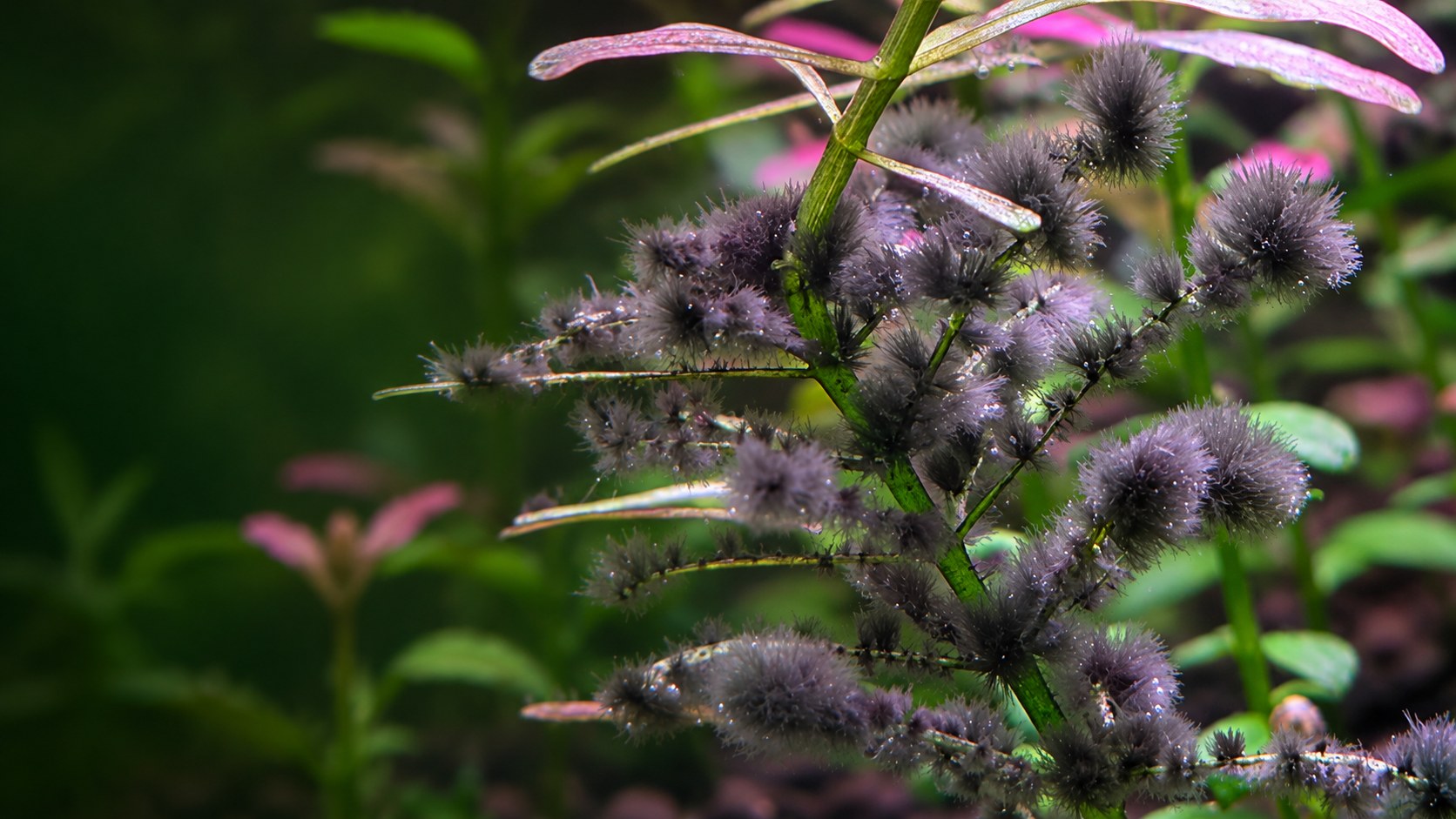
This article focuses on black brush algae, commonly known as black beard algae or BBA. It belongs to the red algae, although its growth usually looks dark grey to black in an aquarium. It forms firmly attached tufts on leaves, decorations and equipment. It is often found on older leaves of slow-growing plants or near the filter outlet.
Its location is a useful clue, but does not establish the cause on its own. Growth on an outlet does not automatically mean that you should reduce overall filtration flow. Likewise, algae on a leaf cannot tell you which nutrient the plant lacks.
Start with what has changed in the tank
Review the last few weeks. Have you increased the light intensity, extended the lighting period, added fish or started feeding more? Has there been heavy pruning or disturbance of the substrate? Also check for gradually clogged hoses, declining filter flow and diffuser performance.
A simple record of maintenance and settings can help. Start with the problems you identify and make further adjustments deliberately. Changing the lighting, CO₂ and entire fertilisation regime at once makes it difficult to tell what actually helped.
Consider CO₂, lighting and circulation together
In planted-tank practice, black beard algae in CO₂-injected aquariums is often associated with unstable CO₂ availability. Watching the bubbles alone is not enough. Check switching times, diffuser cleanliness and water movement between plants, behind decorations and around dense growth.
Aim for even circulation. If the leaves directly in front of the outlet are most affected, try redirecting or dispersing the flow. Reducing the overall flow may create stagnant areas.
If the problem began after increasing the lighting, consider returning to the previous settings that worked. In aquariums without CO₂ injection, match the light intensity and duration to what the tank can support. Black beard algae is not a signal to keep increasing CO₂ without limits; always take fish and other livestock into account when making adjustments.
The presence of black beard algae alone does not identify a single cause.
Check the filter and accumulated debris
Inspect the prefilter, filter media, hoses, intake and outlet. Trapped debris is actually removed from the aquarium when you clean the filter. Match cleaning to its design, instructions, load and flow. If flow drops substantially, do not wait for the scheduled cleaning date. Preserve effective biological filtration.
Remove dead leaves, leftover food and accessible detritus. Pay attention to areas under dense plants, between stones and behind wood. With active substrates, gently siphon deposits from the surface without unnecessarily disturbing deeper layers or roots.
Also check for a surface film and suitable surface movement. A film alone cannot establish the redox potential or the state of nitrification.
Temporarily shorten the water-change interval
When debris is accumulating, we recommend more frequent water changes while addressing the problem, for example twice a week instead of once. Adjust the volume to the livestock and the normal running of the tank. Replacement water should have a suitable temperature and parameters so that maintenance does not introduce further major fluctuations.
Combine water changes with siphoning deposits and removing damaged plant material. Simply draining and refilling water will not remove detritus trapped in the substrate or filter.
Adjust fertilisation to the needs of the plants
Black beard algae alone is not a reliable diagnosis of a deficiency or excess of a particular nutrient. Check doses, combinations of products, source-water parameters and the condition of new growth.
Macronutrients
For supplying macronutrients, we offer products such as Macro Complex and Macro Scape. Match the choice and dose to plant consumption and the nutrients already present in the source water. Where that water contains significant amounts of a nutrient, targeted dosing of individual elements may be more suitable. Changing fertiliser alone is not a treatment for black beard algae.
Micronutrients and iron
Check whether you are using several products containing micronutrients or iron at the same time. Their combined dose may be higher than intended. Plants need these elements, however, so do not automatically stop fertilising. The presence of black beard algae alone does not prove excessive iron dosing.
Interpret tests according to the instructions and the limitations of the method. Check unexpected results by repeating the test or comparing measurements. If uncertainty persists, a laboratory analysis of appropriate parameters may help; it does not replace checking maintenance, circulation and plant health.
Remove affected growth
Gradually remove badly damaged leaves with dense algae growth. Depending on their condition, stem plants can be renewed by keeping clean, healthy tips. Mechanically clean accessible decorations and equipment; removable items are often easier to clean outside the tank.
In heavily affected tanks, do not remove most of the plants at once. Adapt the work to the condition of the aquarium and preserve as much healthy plant mass as possible.
Carbon Complex
In our practice, we use Carbon Complex for targeted spot treatment of black beard algae. Apply the product to affected areas according to the current instructions and include the amount used locally in the total recommended dose. If any part of the procedure is unclear, contact us directly. Combine treating the growth with correcting the problems identified in the tank.
How to tell whether the approach is working
Focus on whether spreading has stopped and new plant growth stays clean. Photograph the same areas once a week. This makes it easier to distinguish old growth from new tufts. Existing growth may not disappear quickly after conditions improve.
If black beard algae keeps spreading, reassess the tank. Do not automatically take this as a reason to increase the product dose. The goal is healthy plant growth and stable aquarium conditions over the long term.
The hero illustration and close-up were adapted from a photograph of an affected plant using AI.